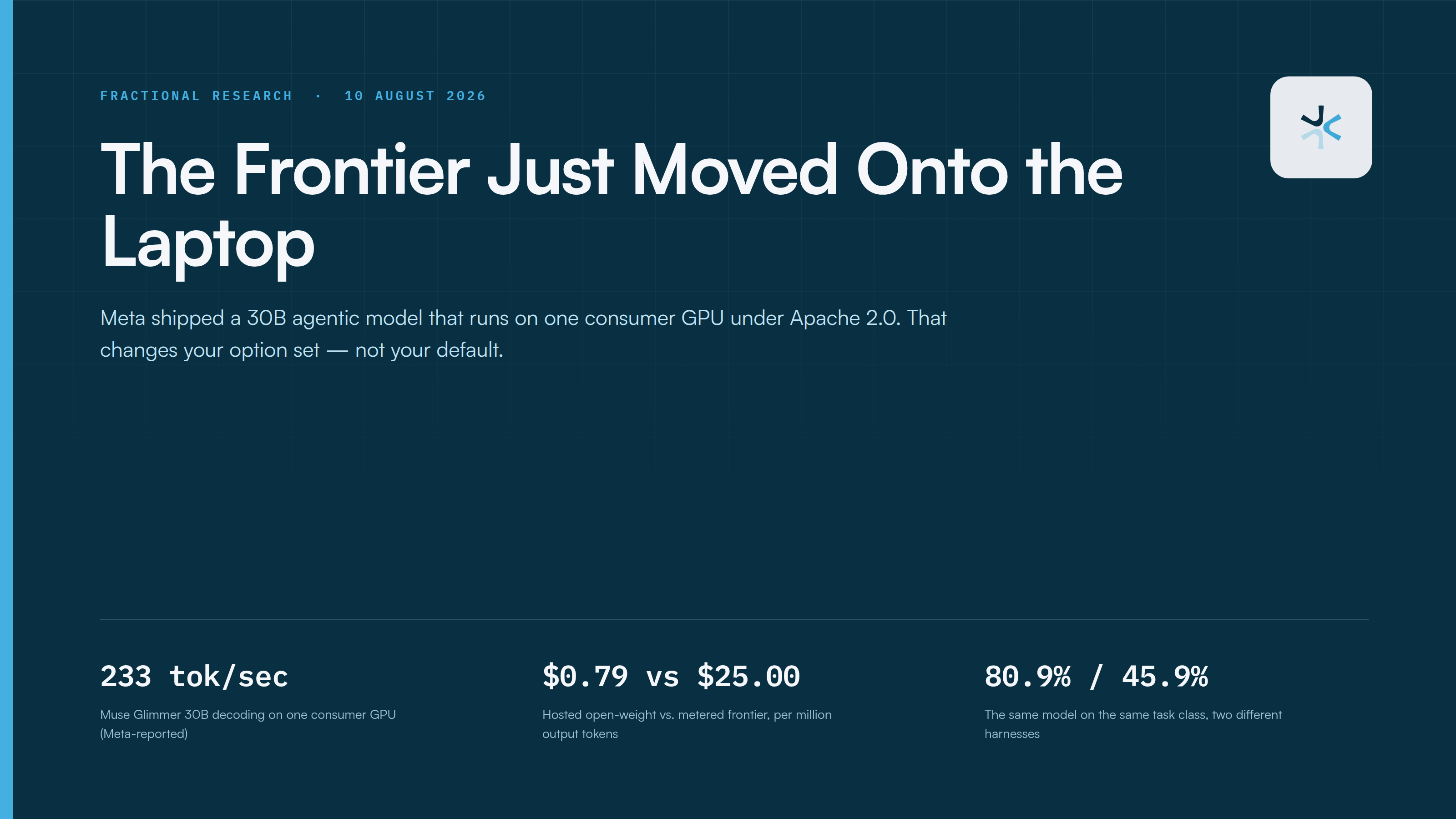
On 10 August 2026, Meta published downloadable weights for a 30-billion-parameter agentic model that decodes at 233 tokens per second on a single consumer graphics card, released under an Apache 2.0 license at no per-token cost. Meta calls it Muse Glimmer. The natural reading of that sentence is that renting frontier inference has stopped being necessary.
That reading is wrong, and it is wrong in a way worth following.
Capable models had been running on one GPU for a while before this. Qwen3-Coder 30B was already the standing recommendation for local coding work, and Qwen 3.6 27B already fit on a single card alongside Gemma 4 and Nemotron 3 Nano Omni. Muse Glimmer did not create the category. What changed on 10 August is that a US frontier lab shipped an agentic model into that category and attached a policy manifesto to it the same day, in which Zuckerberg argued that the United States should loosen its rules on training data and distillation so American open models can keep pace with Chinese competitors. A release with that argument stapled to it turns a specialist option into a question a firm's principals have to answer out loud.
The question is not whether local inference has become good. It is which workloads, if any, should stop leaving the building. Reaching the answer means disposing of two arguments that look decisive and are not.
What Meta actually shipped
Muse Glimmer is a dense causal transformer with a dedicated perception encoder, roughly 30 billion parameters in total including the vision tower. Its attention runs 32 query heads against 2 key-value heads, a sixteen-to-one ratio that holds the memory cost of long context down on a small card. Meta built the model by distilling from its larger Muse Spark, then added agent-focused post-training, and shipped it with a quantized drafter called DFlash that performs speculative decoding.
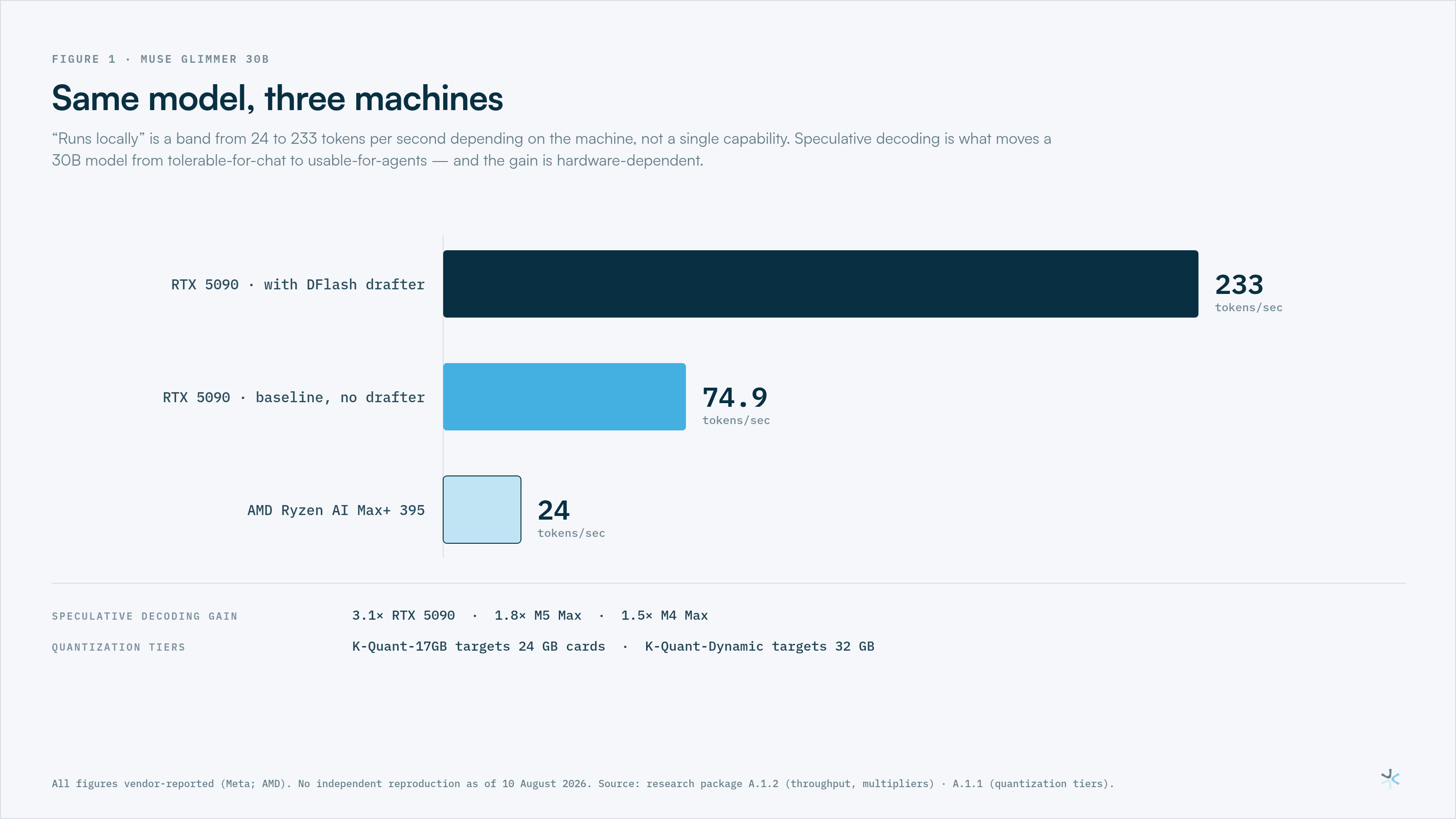
At roughly four-bit precision the model is reported to fit 24 GB of video memory at about 1.0% degradation, with one quantization tier sized for 24 GB cards and another for 32 GB. Sizing guidance written independently of this release puts a 27B model at four-bit comfortably inside 24 GB, and a 34B model inside it with careful context management. That makes the claimed fit ordinary rather than remarkable, and ordinary is the point: a vendor claim that matches what unrelated hardware guidance already expected is a claim worth trusting.
Throughput is where the drafter earns its keep. Decode speed rises from 74.9 to 233 tokens per second on an RTX 5090 with DFlash engaged, a 3.1x gain that falls to 1.8x on an M5 Max and 1.5x on an M4 Max. AMD reports up to 24 tokens per second on a Ryzen AI Max+ 395. Every performance figure in this section, the memory fit and the degradation number included, is the vendor's own, and no independent reproduction of any of them existed at the time of writing.
The license is the part that clears a gate. Apache 2.0 applied to model weights grants commercial use, modification, redistribution and sublicensing, with no acceptable-use policy to map onto a client contract and no user-count trigger. What remains are notice obligations: supply the license, retain the attribution, mark modified files. One question stays genuinely open, namely whether the patent grant reaches the training and inference methods embedded in the weights, which turns on how broadly the word "contribution" is read. Anyone relying on these terms in a client engagement should read the repository's own license file rather than the coverage, since reporting has misstated model license terms before.
Meta and most of the coverage call the release open source. It is open-weight. Meta has not published the training data or the code needed to reproduce the model, which is what the Open Source Initiative's definition requires, and Hugging Face's own write-up describes the release as not a fully reproducible open-source release. None of that weakens the permissions above. It does mean the artifact is a binary whose provenance a buyer takes on trust.
So much for the specification sheet. The first thing worth disputing is whether it describes the machine an agent will actually run on.
Where the spec sheet stops being true
The advertised context window is 131,072 tokens. The working context on a 24 GB card is a much smaller number, and the gap between the two is where local deployments get mis-sized.
A key-value cache grows in step with context length, at roughly 0.109 MiB per token, and at long contexts it can consume more memory than the weights themselves. An 8B model quantized to four bits loads in about 5 GB, yet setting its context to 128K on a 24 GB machine is enough to bring the system to a halt. A 30B model quantized into 17 GB leaves considerably less headroom than that.
The failure mode matters more than the arithmetic. Once the model or its cache no longer fits in video memory, the overflow spills into system RAM and throughput drops from 50 to 100 tokens per second down to 2 to 5. That is not a gentle slope. A machine on the wrong side of it stops being slower and starts being unusable, and an agent session doing file reads and web searches passes 12,000 tokens quickly on its way there.
Hugging Face put the point plainly in its own write-up, treating the context figure as a ceiling rather than a promise that a 131K agent session will be either cheap or reliable, since long context raises both cache memory and prefill time while agent traces fill up with duplicated tool output.
No source gives the sustainable working context for this model on this card, and inventing one would be worse than leaving it open. The rule survives without the number: size the hardware against the context a workload actually holds under load, measured, not against the number on the model card. An operator who buys a 24 GB card because the specification says 131,072 has bought the wrong card for the job.
The same model, two scores
Meta reports Muse Glimmer at 74.6 on DeepSearch QA, 43.3 on Gaia2, 51.2 on SWE-Bench Pro, 94.7 on AIME 2026, 77.0 on IFBench and 80.0 on AA-LCR. Those are real numbers about specific benchmarks, and they cannot carry a deployment decision. That verdict is not a complaint about Meta, which disclosed more than most: the SWE-Bench figure came from Meta's own bash-and-file scaffold and the GAIA2 figure from OpenClaw, both stated.
The disclosure is the admission. Agentic benchmark results belong to the model and the harness together, and the harness moves them by tens of points. Claude Opus 4.5 scores 80.9% on SWE-bench Verified and 45.9% on SEAL, the same model at roughly half the score, with the test harness supplying the difference. Princeton's HAL project runs the same split across its leaderboards, where the scaffolded board shows Claude Sonnet 4.5 at 74.6% while the bare-model board shows GPT-5 Mini at 44.8%. Scaffold architecture has become its own object of study for exactly this reason.
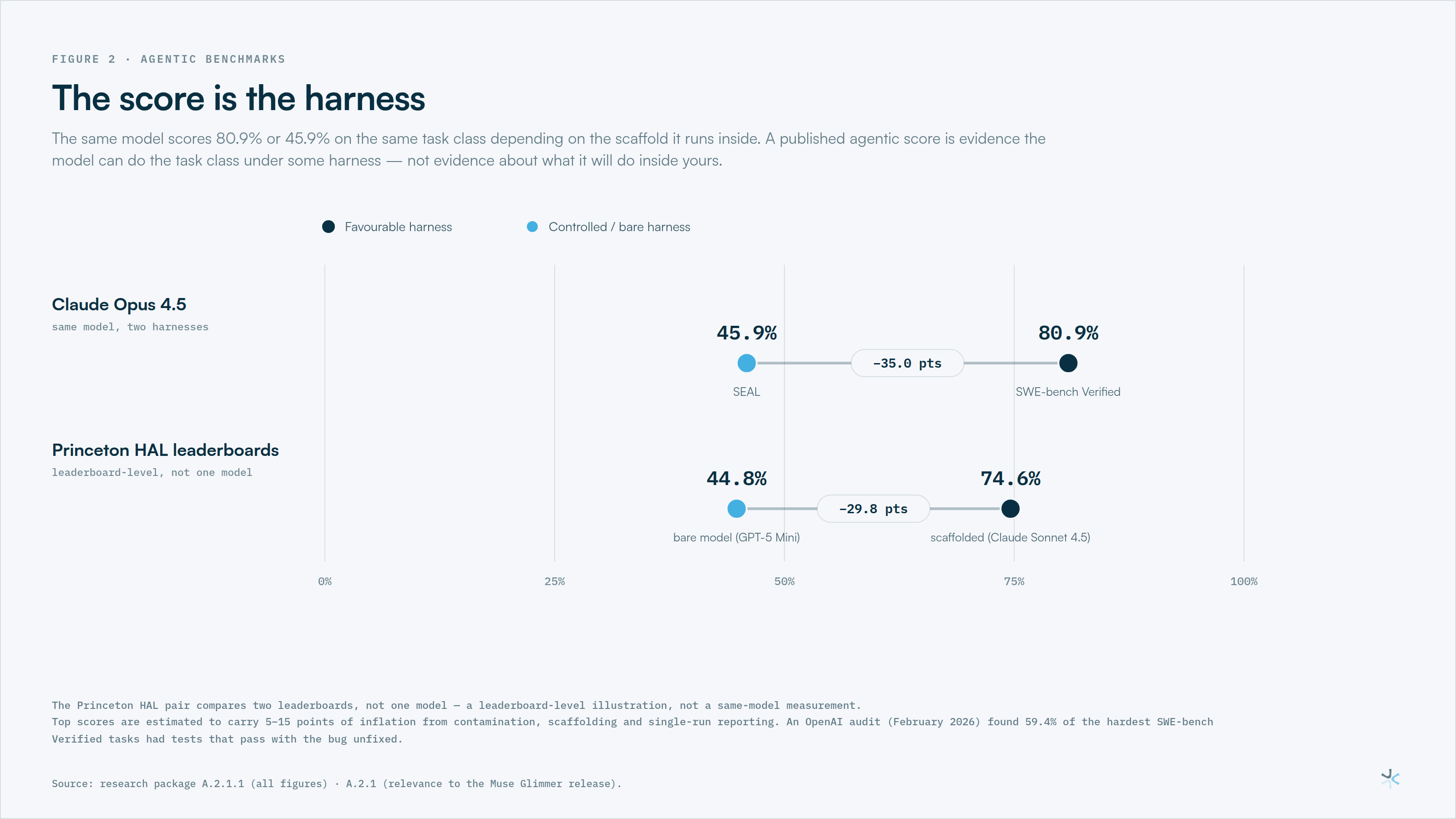
The measurement problems compound from there. An OpenAI audit in February 2026 found that 59.4% of the hardest SWE-bench Verified tasks had tests that pass even when the underlying bug goes unfixed. Separately, roughly a third of SWE-Bench issues carry their solutions in the comments. The same analysis puts 5 to 15 points of inflation into top leaderboard scores once contamination, scaffolding and single-run reporting are accounted for.
Two further cautions apply to this release specifically. Muse Glimmer's numbers are all Meta's, and Hugging Face's assessment is that the model's real value still needs independent, like-for-like reproduction. Within Meta's own comparison table, Hugging Face reads Qwen3.6-27B as winning several practical agent and multimodal tests, while other coverage reads the same table as showing Muse Glimmer ahead of Gemma4-31B and Qwen3.6-27B on several popular benchmarks. That disagreement is unresolved, and a buyer should treat it as unresolved.
One comparison in particular invites error. Muse Glimmer's 51.2 on SWE-Bench Pro sits beside reported figures near 80% for DeepSeek V4 Pro and MiniMax M3 on SWE-bench Verified, and the two are different benchmarks measuring different task sets. Setting them side by side produces a conclusion the evidence does not contain.
None of this makes Muse Glimmer weak. It makes benchmark tables the wrong instrument for the decision at hand, which pushes the whole question down onto cost and data path.
Three prices, not two
Here the article's own framing needs correcting. The gap between metered frontier pricing and locally-run weights is genuine and very large: Claude Opus 4.8 lists at $5.00 per million input tokens and $25.00 per million output, while analyses cost self-hosted inference on electricity alone at $0.001 to $0.04 per million tokens. Three orders of magnitude separate those figures.
The framing that produces them is still a false binary, because a third regime sits between the two. Hosted providers serve open-weight models at 50% to 90% below frontier API pricing. Groq prices most of its catalogue under $1.00 per million input tokens and lists Llama 3.3 70B Versatile at $0.59 input against $0.79 output. Fireworks and Together sit higher on the model where they have been compared directly, at $1.74 and $2.10 per million input respectively.
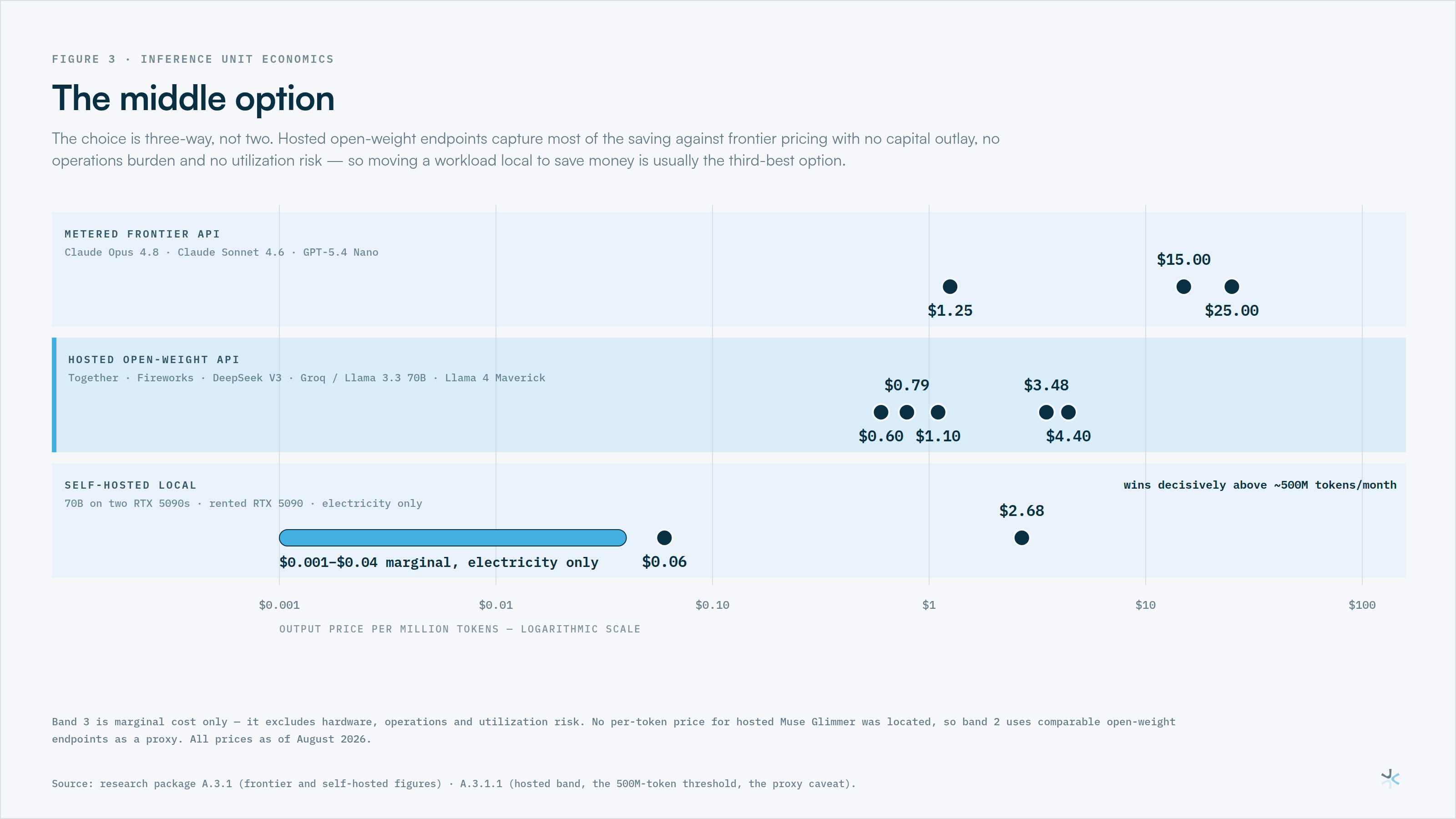
That middle band captures most of the saving with none of the capital outlay, none of the operations burden and none of the utilization risk. The modelled break-even points bear this out. One analysis puts the decisive win for local hosting only above roughly 500 million tokens a month, or where privacy rather than price is doing the deciding.
Published break-even estimates look contradictory until the volumes are read alongside them. One analysis puts hardware payback at under four months at 30 million tokens a day. Another puts it at 18 to 24 months at 3 to 5 million tokens a day. A third sets the practical threshold at about $4,200 a month of API spend, and a fourth at roughly 2 million tokens a day for a 70B model. These are not four different answers. They are one answer, which is that volume decides, and that it decides steeply.
Volume is also not the only thing the per-token line leaves out.
The costs that never appear on the per-token line
Two figures circulate for what self-hosting costs to run, and they differ by four orders of magnitude. One analysis puts the human infrastructure alone at $800,000 to $1,200,000 annually, counting machine-learning infrastructure engineers, a 24-hour operations team, security specialists and performance engineers. Another puts a stable deployment at 5 to 10 hours of maintenance a month, or 60 to 120 skilled hours a year.
Both are right about different things. The first describes a production-grade inference platform serving an enterprise around the clock. The second describes a bounded deployment that does a small number of jobs. A firm running two or three workloads on a workstation is the second case, and quoting the first figure at that firm would be misleading rather than cautious.
What survives is smaller and more useful. The per-token saving of 60% to 80% is real, and the comparison that produces it omits hardware, electricity, operations labor, downtime and the opportunity cost of engineering time. Every published break-even also assumes steady utilization, and research showing six-to-twelve-month payback assumes conditions that rarely hold in practice.
The cheapest levers sit on the other side of the ledger and cost nothing to pull. Caching repeated responses and routing simple requests to a smaller model both change the effective price a team actually pays per million tokens, which moves every break-even point away from local before a single card is bought. An operator who has not done that yet does not have a hardware question.
What local execution is actually for
If cost does not justify local execution below very high volume, the justification has to be the data path.
That case is real and it is specific. A model running on the device completes the work without a network call, which removes the objection that stalls confidential engagements more often than any other: that client material transits a third party. Apache 2.0 is what makes the argument available to a small firm at all, because a bespoke model license carrying an acceptable-use policy would have to be mapped onto every client contract before the first prompt ran.
The direction of enterprise travel points the same way. Reporting on production inference describes a shift toward private and on-premises deployment, driven by data privacy, latency and the wish to keep training data in-house. The specific percentages attached to that shift trace to no named survey with a stated sample or field date, which is reason enough to leave them out. The direction is well attested; the numbers are not.
One constraint carries over from earlier and narrows the field. The workloads that qualify are bounded-context ones, because the context ceiling is not the working context and a long agent session on a small card lands on the wrong side of the throughput cliff. Confidential work that fits inside a modest, measured context window is the candidate. A sprawling multi-hour agent trace is not, at least not on 24 GB.
A procedure, in order
The decision is per workload, and the order of operations matters more than the verdict.
**Exhaust the free levers first.** Turn on response caching and route simple requests to a cheaper model. Both are available today, neither requires a purchase, and together they change the effective price per million tokens that every subsequent calculation depends on. A break-even calculated before this step rests on the wrong number.
**Price a hosted open-weight endpoint second.** At $0.59 input and $0.79 output per million tokens for a capable open-weight model, this tier captures most of the available saving without capital expenditure or an operations commitment. For the large majority of mid-market volumes, this is where the answer lands.
**Reserve local execution for the data path.** Move a workload onto owned hardware when confidentiality, a contractual restriction or latency makes the network call itself the problem, or when volume genuinely clears the 500-million-token-a-month mark. Buying hardware to reduce an invoice below that threshold usually selects the third-best option.
**Settle it with a replay, not a leaderboard.** Whichever regime wins on paper, run the firm's own task set through the candidate model inside the firm's own harness before committing. The scaffold evidence makes this non-negotiable: a published agentic score describes what a model did inside somebody else's scaffold, and a ten-task internal replay is the only test that answers the question actually being asked.
What changed, and what did not
Muse Glimmer changed the option set. It did not change the default.
A capability class that was cloud-only twelve months ago now runs on hardware a firm already owns, under a license that clears a professional-services legal review without a negotiation. That is a genuine shift, and it is worth acting on for the workloads where the data path binds. It is not a reason to move billing off an API, because the middle tier already does that job better for most volumes, and it is not a reason to trust a benchmark table that was produced inside somebody else's harness.
One thing remains genuinely unsettled. Zuckerberg has indicated that Meta will resume releasing open models, and a substantially more capable model at the same license and the same price would move the threshold again. Whether the larger Muse Spark follows Muse Glimmer into open weights is an open question rather than an announced plan, and an operator sizing a decision this quarter should treat the present threshold as the one that applies.